
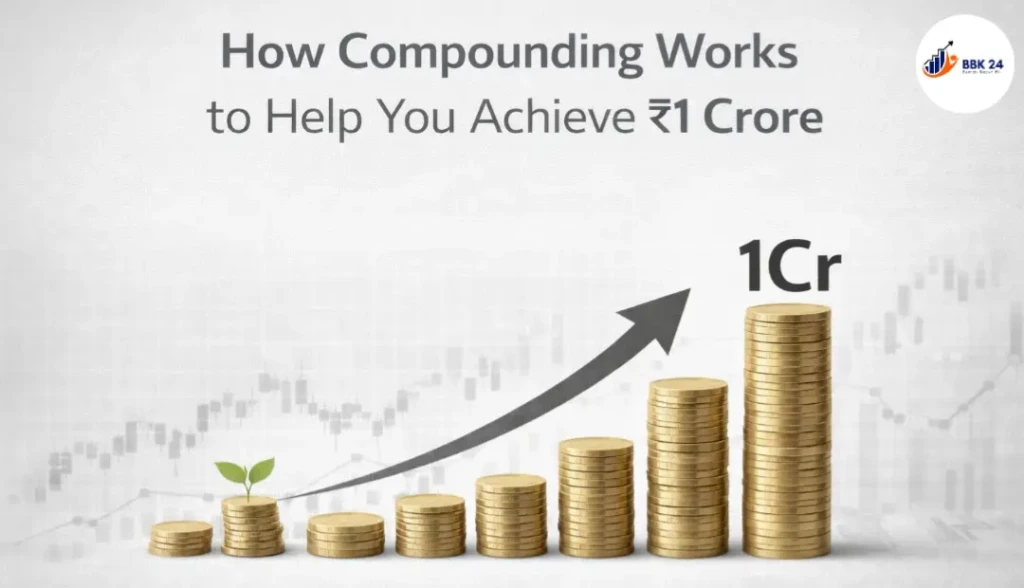
In India, ₹1 crore is more than just a number. For many families, it represents financial security, freedom from stress, and the ability to handle big life goals like buying a house, funding a child’s education, or planning retirement. Years ago, ₹1 crore felt like a fortune. Today, due to inflation and rising costs, it is often considered a practical long-term milestone rather than extreme wealth. The good news? You don’t need to earn lakhs every month to reach it. What you really need is time, discipline, and the power of compounding. Let’s understand how.
What Is Compounding?
Compounding is the process where your money earns returns, and then those returns start earning returns too.
In simple words: You earn interest not only on your original investment but also on the interest already earned.
Think of it like planting a tree:
- In the first year, it grows a little.
- In the next year, it grows more branches.
- Over time, growth becomes faster because the tree is bigger.
- Money works the same way.
For example:
- You invest ₹1,00,000 at 12% annual return.
- After 1 year: ₹1,12,000
- After 2 years: 12% on ₹1,12,000 (not just ₹1,00,000)
- Growth keeps accelerating.
This accelerating growth is the magic of compounding.

How Compounding Helps Build ₹1 Crore
Let’s take a simple SIP (Systematic Investment Plan) example.
Assume:
- Monthly investment: ₹25,000
- Expected annual return: 12%
- Investment period: 15 years
Here’s how it grows:
| Year | Total Investment (₹) | Approx Value at 12% (₹) |
|---|---|---|
| 5 | 15,00,000 | 20,50,000+ |
| 10 | 30,00,000 | 58,00,000+ |
| 15 | 45,00,000 | 1,26,00,000+ |
Total invested: ₹45 lakh
Final value: ₹1.26 crore+
Notice something important: In the last 5 years, the growth is much faster than the first 5 years. That’s compounding at work. Most people quit in the early years because growth looks slow. But compounding rewards patience.
From ₹20,000 Per Month to ₹1 Crore
Let’s say you invest ₹20,000 per month in an equity mutual fund.
- Annual return: 12%
- Time: 15 years
Calculation Summary:
- Total investment: ₹36,00,000
- Final value: Around ₹1,00,00,000+
That means:
You invested ₹36 lakh
Compounding added roughly ₹64 lakh
More than half of the wealth came from growth not your pocket That is the real power of compounding.
Key Factors That Impact Compounding
Compounding is powerful, but four factors decide how big your final amount becomes.
1. Time (Most Important)
The earlier you start, the easier ₹1 crore becomes.
Example:
- Start at 25 years old → need smaller monthly investment
- Start at 35 → need almost double
Time reduces pressure.
2. Rate of Return
Higher returns accelerate compounding.
- 8% vs 12% over 15 years makes a massive difference.
- Equity mutual funds historically have delivered around 10–14% over long periods (though not guaranteed).
Even 1–2% extra return over many years creates a huge gap.
3. Consistency
Skipping SIPs breaks the compounding cycle.
Markets will go up and down. Staying invested during downturns often leads to better long-term results.
4. Reinvestment
If you withdraw profits regularly, compounding slows down.
Reinvest dividends and stay invested.
How to Maximize Compounding
Here are practical Strategy / Mistake
| Strategy / Mistake | Details / Explanation |
|---|---|
| Start Early | Even ₹5,000/month at age 22 can outperform ₹20,000/month at age 35. |
| Increase SIP Every Year | Raise SIP by 5–10% annually as income grows (Step-up SIP). |
| Stay Invested During Market Falls | Market corrections are normal; long-term investors benefit from volatility. |
| Avoid Frequent Switching | Jumping between funds disrupts growth and reduces compounding benefits. |
| Focus on Long-Term Goals | Compounding requires 8–10+ years to show meaningful results. |
| Starting Late | Waiting for the “perfect time” costs years of growth. |
| Stopping During Market Crashes | Exiting during downturns reduces wealth; staying invested builds long-term gains. |
| Withdrawing Too Early | Breaking compounding midway dramatically reduces final wealth. |
| Expecting Quick Results | Compounding feels slow initially; patience is essential. |
| Ignoring Inflation | ₹1 crore today won’t have the same value in 15–20 years; adjust planning for inflation. |
Step-by-Step Example: Building ₹1 Crore in 15 Years
Let’s break it down clearly :
Goal: ₹1 crore
Time: 15 years
Expected Return: 12% annually
Using SIP formula (standard financial calculation):
Required SIP ≈ ₹20,000 per month
Step-by-step logic:
- Monthly investment compounds every month.
- Returns accumulate.
- Growth accelerates in later years.
- Final amount crosses ₹1 crore around year 15.
If return is lower (say 10%), required SIP increases.
If time is longer (say 20 years), required SIP reduces significantly.
That’s why time is more powerful than high returns.
The Emotional Side of Compounding
Compounding rewards:
- Patience
- Discipline
- Long-term thinking
It punishes:
- Panic
- Impatience
- Emotional decisions
The biggest challenge is not mathematics — it’s behavior.
Conclusion: The ₹1 Crore Formula Is Simple
To summarize:
- Start early
- Invest consistently
- Stay invested long term
- Reinvest returns
- Increase SIP gradually
Compounding is not magic. It is mathematics plus time.
You don’t need to predict markets. You don’t need to trade daily.
You just need discipline and patience.
If you give compounding 10–15 years, ₹1 crore becomes a realistic target — even for a middle-income investor.
Final Note (Important)
All investments are subject to market risks. Returns are not guaranteed, and past performance does not ensure future results. Always assess your risk tolerance and consult a qualified financial advisor before investing.
Disclaimer: BBK24.COM provides news and information on markets, economy, business, and personal finance for informational purposes only. We do not provide financial advice, and any action you take based on our content is at your own risk. Please consult a licensed professional before making investment decisions.