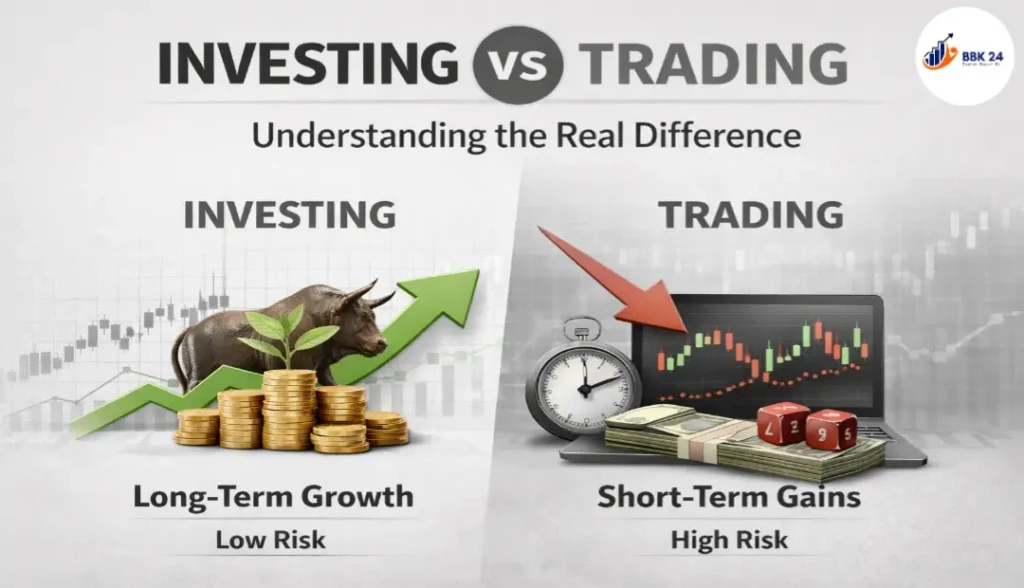
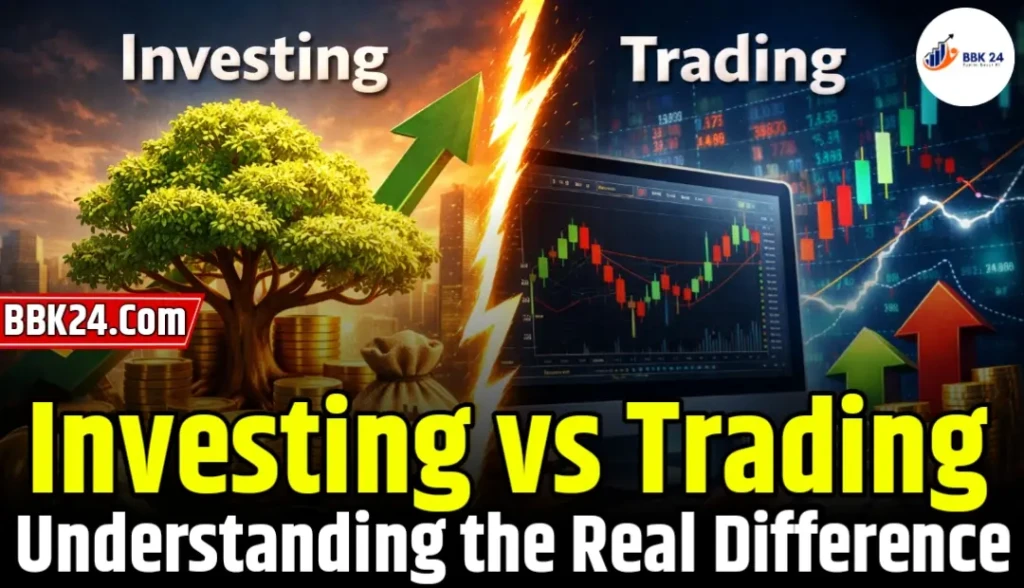
Quick Summary: Investing and trading both involve participating in financial markets, but they are built on very different ideas. Investing is about owning assets for the long term and allowing wealth to grow gradually. Trading focuses on shorter-term price movements and aims to generate quicker profits.
The difference goes beyond time. It includes risk exposure, required effort, emotional discipline, taxation, and personal temperament. Choosing between them depends less on what sounds exciting and more on what realistically fits your goals and lifestyle.
Why Many People Mix Them Up
At first glance, both investors and traders buy and sell shares. Because of that, many beginners assume they are doing the same thing.
But the intention behind the purchase is completely different.
An investor buys with the expectation that the business will grow over years.
A trader buys because they believe the price will move in the near future.
That difference in purpose changes everything — how decisions are made, how risk is handled, and how success is measured.
What Investing Really Means
Investing is based on ownership. When you invest in a company, you are effectively becoming a small partner in that business.
Instead of focusing on daily price swings, investors look at:
- Revenue and profit growth
- Financial stability
- Industry potential
- Competitive advantages
- Management quality
The assumption is simple: strong businesses tend to increase in value over time. Short-term volatility is accepted as part of the process.
One of the most important forces in investing is compounding. When returns are reinvested, they begin to generate their own returns. Over many years, this effect can significantly increase wealth.
Investing does not require constant activity. In fact, overreacting to market noise often harms long-term results.
What Trading Involves
Trading is more active and tactical. The focus is not long-term ownership but short-term price behavior.
Traders usually analyze:
- Price charts
- Patterns and trends
- Market momentum
- Volume movements
- News-driven reactions
Positions may last a few minutes, a few days, or sometimes a few weeks. Timing matters greatly. Entry and exit decisions must be precise.
Because markets can change quickly, trading requires attention, discipline, and emotional control. Even experienced traders face periods of losses. Risk management is not optional — it is central.
While trading can produce faster gains, it also exposes capital to faster losses.
Time Horizon: The Core Difference
If you reduce the debate to one factor, it is time.
Investors think in years or decades.
Traders think in shorter cycles — sometimes intraday.
Time changes how risk behaves. Over long periods, markets have historically trended upward despite temporary declines. In short time frames, however, prices can move unpredictably.
This is why investing often feels calmer, while trading feels more intense.
Risk: Not Higher or Lower, Just Different
It is common to hear that trading is riskier than investing. In many situations, that is true — but the real difference lies in the type of risk involved.
Investors face:
- Economic slowdowns
- Market corrections
- Company-specific issues
However, long holding periods allow time to recover from temporary downturns.
Traders face:
- Sudden volatility
- Execution mistakes
- Overtrading
- Emotional reactions
Because trades are short-term, there is less time for recovery if a position goes wrong.
In simple terms, investing spreads risk over time. Trading compresses it.
Effort and Lifestyle Fit
Investing can be suitable for individuals with full-time careers or limited market time. After proper research and asset allocation, portfolios may only require periodic review.
Trading is more demanding. It requires:
- Daily market observation
- Strategy development
- Performance tracking
- Emotional resilience
For many, trading functions like a profession rather than a side activity.
Understanding how much time you can realistically dedicate is crucial before choosing an approach.
Taxation and Costs Matter More Than You Think
Frequent buying and selling comes with transaction costs. Brokerage fees, slippage, and taxes can reduce actual returns.
Long-term investments often benefit from relatively lower capital gains tax rates (depending on local regulations). Fewer transactions also mean lower cumulative costs.
Short-term trades may attract higher tax rates and increased brokerage charges. Even profitable trading strategies can underperform if costs are ignored.
Net returns — not gross gains — are what ultimately matter.
A Simple Practical Comparison
Consider two individuals starting with the same capital.
One builds a diversified long-term portfolio and holds through market cycles, reviewing periodically.
The other trades actively, entering and exiting positions frequently.
The investor’s outcome largely depends on discipline and market growth over time.
The trader’s outcome depends on accuracy, risk control, and consistency.
Both approaches can succeed — but the skills required are very different.
The Psychological Challenge
Markets test emotions more than knowledge.
Investors must stay patient during downturns and avoid panic selling.
Traders must control impulsive decisions, especially after a loss or during a strong winning streak.
In both strategies, emotional stability often separates sustainable performance from repeated mistakes.
Can You Combine Both?
Yes, and many experienced market participants do.
A balanced approach often involves allocating a majority of capital to long-term investments while reserving a smaller portion for trading activities.
This structure allows steady wealth building while limiting overall risk exposure.
Clear separation between investment capital and trading capital is important to avoid confusion.
How to Decide What Suits You
Before choosing, ask yourself:
- Am I comfortable with short-term uncertainty?
- How much time can I realistically dedicate?
- Do I prefer steady growth or active engagement?
- How well do I handle financial stress?
There is no universal answer. The right choice depends on your financial objectives, personality, and discipline.
Frequently Asked Questions
Is trading guaranteed to generate faster profits?
No. While profits can occur quickly, losses can happen just as fast. Consistency is difficult and requires skill.
Is investing completely safe?
No investment is risk-free. However, long-term diversified investing has historically reduced the risk of permanent capital loss.
Can beginners try both?
It is generally advisable to understand long-term investing principles first before committing significant capital to trading.
Do taxes significantly affect returns?
Yes. Transaction frequency and holding period can meaningfully influence after-tax performance.
Final Thoughts
Investing and trading are not rivals. They are different strategies designed for different objectives.
Investing rewards patience and long-term thinking.
Trading rewards discipline, timing, and risk control.
Success in either approach depends less on market prediction and more on clarity, consistency, and realistic expectations.
Financial Disclaimer
This article is for educational purposes only and should not be interpreted as financial, investment, or tax advice. Market participation involves risk, including possible loss of capital. Readers should conduct independent research or consult a qualified financial professional before making investment or trading decisions.